
Clinical research often excludes the diversity of everyday life, making real-world access to psychedelic therapy look very different than a trial setting. As Dr. Alan Davis highlights, thorough preparation and a safe, trusting therapeutic relationship are essential to preventing harm and fostering genuine healing.
Key Takeaways
- The Human Connection to Healing: Clinical trials often try to isolate a drug’s biological effect, but decades of psychotherapy research show that therapeutic alliance and thorough preparation are the primary drivers of positive outcomes.
- Clinical Trials Exclude Real-World Realities: Rigid screening criteria in research leave out the complex, diverse realities of everyday people, highlighting a need for naturalistic and community-based settings to understand how psychedelics work in practice.
- Internal Protection Isn’t Brokenness: Trauma-response mechanisms like dissociation or hypervigilance are protective strategies built for survival; healing requires a slow, gentle approach rather than trying to “demolish” one’s defensive structures overnight.
- Psychedelic Passage: Your Psychedelic Concierge — The easy, legal way to find trustworthy psilocybin guides, facilitators, and psychedelic-assisted therapy near you in the United States.
Dr. Alan K. Davis is a Clinical Psychologist and the Director of the Center for Psychedelic Drug Research and Education (CPDRE) and Associate Professor of Social Work, Psychology, and Internal Medicine at Ohio State University.
Their research explores the safety and efficacy of psychedelic-assisted therapies for people with addiction and mental illness. Alan has published over 125 scientific articles and book chapters. Their work spans seminal clinical trials of psychedelic therapy for depressed people, Veterans with PTSD, and lung cancer patients.
They further innovate via a focus on the use of psychedelics among vulnerable populations in order to make psychedelic research more accessible.
Alan has also launched education initiatives that span workforce development initiatives, multi-day clinical training workshops, online certificate programs for communities and students, and field/practicum training for trainees in behavioral health disciplines.
Today’s conversation will focus on Alan’s experiences that led him to this career, as well as what it’s really like being a part of psychedelic clinical trials. We’ll finish up with a deeper conversation about psychedelic work in general and hopes for the future of the psychedelic field.
More From Our Guest:
- Follow Dr. Alan K. Davis on LinkedIn
- The Center for Psychology Drug Research and Education at the Ohio State University
This article is inspired by our insightful podcast episode hosted by Psychedelic Passage co-founder, Jimmy Nguyen, which you can listen to on all streaming platforms. Read on as we highlight some of the best moments in our interview with Dr. Alan K. Davis.
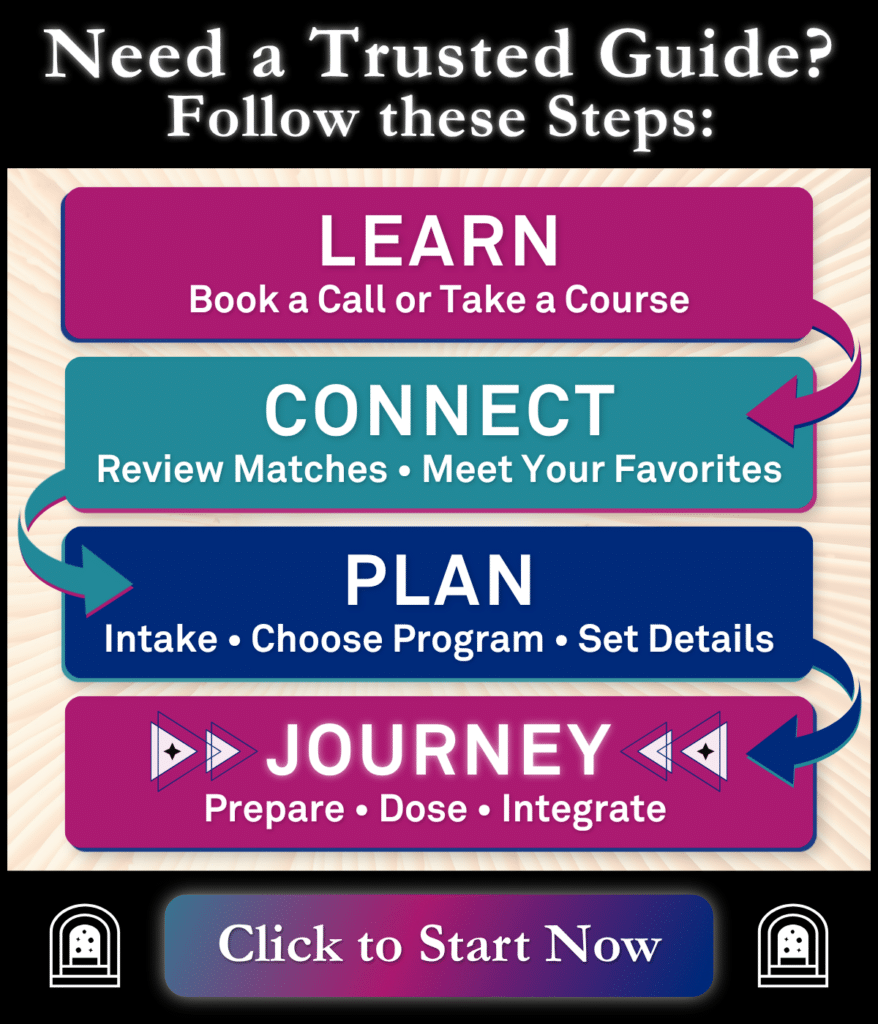
Start your Pathfinding today
Our network of vetted, professional guides are here to help you through every step of your journey. We offer a free online course or a 15-minute phone call to help you find the best facilitator match for your unique needs.
This conversation began at the 2025 Psychedelic Science Conference in Denver, CO, where our founder, Jimmy, attended a panel on psychedelic progression in the Midwest. On that panel was Dr. Alan K. Davis, whom Jimmy described as a “breath of fresh air” in the psychedelic industry, where many are afraid to ask the hard questions.
Another member of that panel was Sue Sisley, the first researcher to get approval from the FDA to use whole mushrooms in her clinical trials, something that’s a rarity in psychedelic research where synthetics and analogs are the norm.
Immediately after the panel, Jimmy sought out Dr. Davis to introduce himself. Over a year later, we’re honored to share this conversation with a researcher at the forefront of the field, who approaches his groundbreaking work with remarkable humility and honesty – reminding each of us that we’re all on the same journey, having the same psychedelic experiences, feeling the same oneness, awe, and humanity.
“We’re all just walking each other home.” ― Ram Dass.
The Origin Story of Dr. Alan K Davis
Jimmy Nguyen: Can you share a little bit of whatever you’d like to about your journey here so far? Now, you were at Johns Hopkins in 2016. You had worked on some of those studies and trials. I’m sure that there was a story before that. I’m sure that there’s for sure a story after that. So where do you want to begin in telling the audience about your psychedelic story?
Dr. Alan K. Davis:
“You know, I am someone who for much of my adult life was in a variety of spaces of curiosity and just really kind of very intentionally curious about the world around me, about humans and relationships and behaviors so it’s not surprising that I became a psychologist and a therapist.
But what a lot of people don’t know is that the reason why I was in that space of looking outward and spending so much time thinking about others and thinking about ways I could be of service to others was actually driven by a real dissociative tendency to avoid my own internal states.
And that comes from what I now know to be childhood trauma and growing up in a family that did not have a lot of secure attachments. So, yes, the work that I’m doing professionally, I think, is exciting. I think it’s meaningful. However, the reason I got there and how I got there was really because of this lifelong journey to become, first, better able to help others, but really the big thing is also: how do I help myself?
How do I figure out how to be a human, a full human, a fully experiencing human that is able to act and feel and live in ways that are consistent with my values? That’s led me to some work and some curiosity and some interest in this space that in some ways served a purpose of helping me do that.”
Where did psychedelics come into play here?
Dr. Alan K. Davis:
“My first experiences with psychedelics were probably like most people, as a teenager, late teen, who was experimenting and not really doing anything intentional. But actually my first psychedelic experience was at the time and I think for a long time, what I would colloquially refer to as a bad trip.
I was given two hits of acid and no guidance or preparation or understanding of what that drug was or what it was going to do to me. And then proceeded to have a pretty destabilizing, kind of anxiety-provoking experience that the people I was with didn’t know what they were doing either. So no one really knew how to handle the dysregulation that was coming up, for me or for anyone else in the room.
And I left that experience really altered in a way and actually would not return to psychedelics for a while because of it. And for a long time I was really scared and leery of these substances.
Flash forward a little bit. I, in my early twenties, had some experiences with MDMA that were much more pleasant and much more enjoyable. I had some experiences with psilocybin as well that were more enjoyable, but it was all in this kind of recreational lens. There wasn’t really much therapeutic, or at least that I didn’t interpret at the time, therapeutic content.
So I didn’t really know of psychedelics as potential medicines until much later, once I finally got into grad school, which was in my early 30s, and started really being curious about why the current treatments that we had out there to treat mental health problems weren’t effective. And that’s what led me to some of the research at Johns Hopkins and learning that there are potential alternatives here that might be much more effective.”
Jimmy Nguyen: Are you open to me just circling back and just talking about this first experience of yours? You obviously have consent here on how far you want to go and what you want to say. Did that linger for you after a while, or did you mentally kind of say, ‘Well, that was nuts, let me just kinda tuck it away, put it on a shelf and move on?’
Dr. Alan K. Davis:
“I was a senior in high school at the time. There were a lot of different things going on. I think to a large extent I kind of just tucked it away. I kind of just moved on. I didn’t really have any understanding of what happened, and I didn’t really have anybody I could talk to about it. I largely just tried to put it away, and it wasn’t until years later that I really started to think about what happened. I mean many years later, like probably twenty years later, like in the last five years or so, well into my career as a psychedelic researcher and psychedelic therapist.
I think in some ways I knew it was back there but I didn’t really have, even as someone who now has a professional and personal vocabulary of psychedelic medicine and experience, I think I didn’t really fully appreciate how important the context was and what occurred to me under that experience.”
Jimmy Nugyen: As you look back on that now, it seems like that’s had quite an impact on who you are – your values, what you do, and how you serve.
Dr. Alan K. Davis:
“Absolutely. I mean, certainly it’s had an impact on me personally and in many ways. Professionally, I started my career in psychedelics in graduate school, and the first studies that I did were looking at harm reduction. And so from a very early early phase, you know, 2010 when I started this work, my goal was to to understand how people can keep themselves safe.
And then later, and especially as I moved into clinical trial work and really getting a better understanding of the nuances of safety within psychedelic spaces and the levels of safety within psychedelic space and in my own personal psychedelic work as an adult has led to why the word education is in the name of my center.
It’s one of the reasons why we spend so much effort in creating programming to educate the public because I want people, if at all possible, to avoid that type of trauma and destabilization with psychedelics.
The more information that people can have, the more prepared they are. It’s why we spend so much time in preparation therapy in our clinical trials. It’s why we have well-trained clinicians that go through a long-term apprenticeship model. It’s all in service, at some level, of this route of wanting to protect people from some of the harms that I’ve experienced firsthand.”
Jimmy Nguyen: Can you talk about this part that you just mentioned? The depth of preparation in clinical trials? I think that the effect of our current society is that most people are consuming information and content in little snippets, little snapshots, little sound bites, little headlines. And obviously if anybody’s taken the time to read through any of these clinical trials, like they’re quite in depth and quite rigorous.
Most people leave with, ‘Wow, this one experience, the experience itself was the thing that created ten years of therapy,’ which I don’t fully discredit, but I don’t think it’s the whole picture.
We have a lot of folks who are leaning towards clinical trials for a couple of reasons. One is that it’s the closest thing to validating psychedelics through a scientific and medical lens. Therefore, people kind of look at it as the gold standard of psychological care and psychological therapy. I think there’s kind of a confusion there.
The other is that it’s one of the legal pathways, though I think people underestimate how much effort goes into it as probably both the organization and the professionals running the trial as it is the participants. So I know that you have some experience here for sure.
Recommended Reading: How to Join a Psychedelic Clinical Trial in 3 Steps
Dr. Davis’s Psychedelic Research
How many clinical trial processes have you been through in some capacity or another?
Dr. Alan K. Davis:
“In terms of the number of clinical trials at this point, I think like half a dozen or more, that I have either run, led, consulted on or have co-investigator status on. I’ve done more than, I think at this point, 50 or 60 sessions directly with people in those studies where I’ve actually facilitated the sessions and of course trained a lot of people within those settings to provide services in these studies.
They are by far and away the most time-consuming, grueling, difficult research that I’ve ever done. and I feel like there’s some consensus around that with what I know of other psychedelic researchers.
In part, it’s because of the regulatory hurdles, the stigma, and the lack of infrastructure and resources. We really are, in a number of ways, rightly or wrongly, paving the road toward broader medical access.
I by no means think that medical access should be the only access or is the best type of way to do psychedelics. By no means do I want to assert that. But for a large proportion of people in this country, that will be the only way that they feel safe to do it.
And for those that have mental health issues and medical comorbidities and other challenges, those settings will likely be the place where they are able to experience psychedelic therapy. And within that context, it’s a lot of time and effort. There’s a lot of fires every day that need to be put out in order to do good work.
I think there’s a lot of debate within the psychedelic ecosphere, especially when you start to widen that lens from just clinical trials to the business enterprise of psychedelics that’s growing and the marketability of producing psychedelic medicine that can translate from clinical trial and testing into the market. And what I’ve noticed personally is that as that lens grows bigger, as we move closer towards the market and FDA approval, as we move closer to widespread access, there has been a diminishing narrative of the importance of preparation therapy.
In fact, there are some people that say that the therapeutic piece of it should not exist at all. And frankly, there’s a number of these companies that, because of pushback from the FDA to isolate the drug effect and the pharmacological effect, because of this misnomer that a biological reductionist mindset is going to lead us to an answer and to isolate purely what a psychedelic is doing in the brain, that somehow that means that the minimization of psychedelic therapy or the therapeutic component is going to lead to better outcomes.
What I want to say about that is two things. The first thing is that I personally believe in the work that I’ve done on myself and the work that I do professionally in psychedelic therapy trials is that therapy is crucial. And it might look different than some traditional psychotherapy sometimes. Sometimes it looks exactly like traditional psychotherapy.
But there’s an effort and emphasis to minimize it because I think people want to figure out what’s the least common denominator that I can sell to somebody that I can get through an approval process. With the least amount of barriers, so that I can start profiting from it. But what’s actually happening, I think, even when you look at these trials, for those people who aren’t familiar with reading these types of studies or really understanding the nuance of the language, when you look at what they call psychological support or this minimal psychological support process, that still is psychotherapy.
We have at this point, I don’t know, 60 years of research outside of psychedelic therapy in the regular psychotherapy literature. 60 years or more now of evidence that suggests that beyond what the treatment is, beyond what the condition someone has, beyond what the setting is, every time the most consistent predictor of outcome is the therapeutic relationship, is the alliance, and the safety that that provider and that client could co-create in that session. And of course, that pertains to psychedelic therapy as well. In fact, it might actually be the driver that drives the most. So I personally believe that is critical and that’s why we spend so much time doing it.”
Can you talk to me a little bit about the nature of some of these trials?
Dr. Alan K. Davis:
“The scientific method that we were kind of talking about here also could just be described as a way to dismantle and appropriate to create technology that already exists. And I think that the dismantling and the isolating of these factors and these variables so that it can be reduced to a simple thing that then can be commodified is ultimately what I think is wrong with the scientific method and why the scientific method in large ways has failed when applied to psychedelic therapy. Because there is no suitable blinding so far that we’ve been able to find.
Most studies are not blinded, or if they are, they’re easily broken, right? People can easily tell whether or not they’ve received a psychedelic, generally speaking. It’s not always the case. I’ve certainly sat as a therapist in sessions in double-blind clinical trials where I was convinced someone had a psychedelic, they were convinced they had a psychedelic, and sure enough, there was no psychedelic that went into that person.
This blinding question is really challenging. Personally, the studies that I’ve worked on have predominantly been studies that are open-label, and what that means is that we don’t have a blind.
We also don’t have a control of some kind, in part because the questions that I’ve been asking have really been pushing into new populations, new conditions. And so, therefore, from an FDA perspective, those types of studies typically don’t have controls. They could, but the point of them is to determine whether it’s safe. The question around control or efficacy is usually secondary.”
Insights into “Safety, feasibility, and preliminary clinical outcomes of psilocybin-assisted therapy for veterans with severe, treatment-resistant PTSD: an open-label pilot clinical trial”
So, in our recent clinical trial of veterans with PTSD, where we gave them psilocybin therapy, two doses of psilocybin with approximately you know 13 to 15 hours of psychotherapy. In that study, the primary aim was: can we do this safely? It was the first psilocybin trial in PTSD, and with veterans with severe treatment-resistant PTSD. So these were veterans who had tried multiple other treatments, typically had tried both medications and psychotherapies. None of them had been effective in reducing their symptoms to a degree that they wanted. They still had severe symptoms.
And what we found was that you know this treatment led to 75% of them being in complete remission after the treatment was completed. That study was published this summer in Communications Medicine. We’re actually working now on some follow-up data up to six months after their treatment. And what we find is that there actually seems to be this continual unfolding of a therapeutic response.”
Jimmy Nguyen: The plain language summary says, this study explored whether psilocybin-assisted therapy, PAT, a therapeutic approach being studied for the treatment of several mental health conditions, could help U.S. military veterans with severe treatment-resistant post-traumatic stress disorder. Veterans completed therapy sessions before and after receiving two doses of psilocybin.
Researchers monitored safety and changes in symptoms for one month after treatment, no serious safety problems occurred, and most side effects were mild, such as headaches or brief anxiety. Veterans showed large improvements in PTSD symptoms and many no longer met criteria for PTSD after one month.
These results suggest that PAT may offer meaningful relief for veterans who have not found help through standard treatments. And obviously, more research is needed.
Dr. Alan K. Davis:
“We did a number of things in this trial that were, at the time, different from a lot of the trials that have been done up to this point. The typical treatment profile for a lot of the first studies were two preparation sessions, typically four hours in length, big doses of psychedelics and then some integration. But for a PTSD population, especially veterans who have a lot of difficulty in building trust and rapport, the trauma itself often makes people feel isolated and that the world can’t be trusted, that people can’t be trusted.
So we we really did what we could to slow things down as much as we could in the study design, meaning we spread out the preparation therapy over four weeks. We met for shorter chunks of time, really to try to extend and build as much trust and rapport as possible.
But what we also did is we started off with a lower dose of psilocybin. So we started off with 15 milligrams (equivalent to ~1 gram of whole, dried mushroom) in the first session. And for reference, the kind of general clinical dose that seems to have converged in trials is 25 milligrams.
We started off with a lower dose in part because we wanted to give veterans an opportunity to get their feet wet with the medicine, but also to practice not being too deep in it because we didn’t want to overwhelm them. We didn’t want to throw them over the deep end of their nervous system, and frankly, we didn’t want them to just dissociate through the entire session.
So we started off with that lower dose. We had a couple of weeks in between those sessions, and then we went up to the therapeutic dose of 25 milligrams in the second session.”
The House Metaphor: Opening the Psyche Gently
Jimmy Nguyen: I see. Yeah, start low and go slow is obviously a harm reduction practice. I’m also hearing some of your influence and essence in there, knowing that these folks who are trauma survivors, you’re a trauma survivor. There can be these very intricate systems of protection, but that protection can lead to blockages.
So the imagery that I have in my mind is if you are a house, you can’t demolish the whole house, obviously. So if you are going to let’s say reconstruct the house, and the house also has a moat and it has all of these walls built up around it. If you take a sledgehammer to the thing, then you’re going to have a whole bunch of debris and stuff that you’re going to need to clear out before you can get to the reconstruction.
But if you take your time and methodically say, okay, this is going to come down and this is going to give us access to this thing, and we also need to keep the plumbing intact, and so on and so forth, then that likely would create, I’m not a general contractor or a construction guy at all, but that would likely create a cleaner site and less chaos around this. And so that makes a lot of sense to me to slow things down because I know with the thousands of folks that we’ve chatted through in our organization and community that people want to get going.
They’re like, ‘I’ve been suffering for my whole life. I want to get done with this. I want to have this behind me. I want to move forward in my life. Tomorrow is not promised, and I’m done suffering,’ which is so valid. My heart breaks because I’ve been there. My heart really breaks for these folks. And oftentimes when you tell them to slow down, there can be this resistance.
Maybe you have some authority to be like, well, it’s the clinical trial, this is how it’s going to be. But I don’t blame people for wanting to take like a sledgehammer to their issues. So that makes a lot of sense for me.
Where was the decision to try to land at 25 milligrams for the second administration?
Dr. Alan K. Davis:
“The decision really was because of the coalescing around that number in the trials at the time. And importantly because once you get above that number, once you get into like 30, 40 and above milligrams, then the rate of possible adverse events increases, generally not serious adverse events, but certainly more challenges can come with anxiety, with paranoia and other things, depending on the setting. So as a first in this population trial, we really wanted to minimize that in order just to determine if there was safety and also if there was a sign of clinical effect, because if there was, then hopefully the next trials and future studies can start to ping that a little bit differently.
I really loved the sledgehammer and house metaphor, and I want to just unpack that for a moment because I think one of the big misnomers that people have, and I think I’ve had this as well for my own personal healing journey, is that something is wrong.
You know, ‘I have this condition, or I have this difficulty. I’ve had it forever. I want it to go away. So therefore, I might as well just break down the whole house,’ right? Like the whole thing is gone. But actually, I think what’s actually happening for people is that the house is actually housing in a way that has kept you safe and alive and got you to this point. And it’s actually not all bad. In fact, I think the idea that mental health conditions are bad or negative is largely because of the difficulties that come with them.
But I actually think that the reason why we have them is often because of a protective, systemic survival mechanism that has actually facilitated your capacity to survive and live. But unfortunately, has these circular drawbacks like rumination and fear and anxiety and depression. It comes with stuff. Right?
Dissociating from your nervous system comes with stuff. You know? But it also helps you get through it. It also helps you show up during the day and eat and try to take care of people that you care about and work and whatever else is important to you.”
Jimmy Nguyen: It makes sense why your follow-up was only one month because it would be curious to see what happens to folks in three, six months, nine months, twelve months. Of course we want to check in with people and see how they’re doing, but there’s so many factors at play.
You can take somebody who has, let’s say, an abusive dynamic in their home, and they can go and have these psychedelic experiences, but if they then have to go back to their abusive environment or their scarcity environment or their environment of a lack of food security or housing security or many of the things, economic pressure, let’s say, like many of the things that Americans are dealing with today.
I had a client who was absolutely heartbroken a couple of months ago saying, ‘Well, everybody else is getting this healing. Why not me? Why can’t it be me? When’s it my turn?’ I’m combining a couple of clients’ thoughts and sentiments, but that’s so real. Of course, that might reinforce this feeling of people being broken or that they’re not doing it right. It’s just like pulling something deep within my soul that I feel like needs to be said out loud.
The Nuances of Clinical Trials
Dr. Alan K. Davis:
“Even that is absolutely challenging, and I hear that from a lot of people as well who are ready and wanting but don’t have access yet. Even for those that do get into the studies or find it through other mechanisms, God forbid they don’t have the prototypical experience that gets talked about in the media, because then there is also a lot of this like self-stigma and shame of like, ‘God, I didn’t get the healing in the way that I’ve heard about it in these clinical trials’ or the way that someone talked about it in Michael Polan’s book or a news report or wherever.
I want people to know that had I gone through my own trial as a patient, I don’t think I would have been in remission after that study. Because my personal healing journey has not been as straightforward as two doses of psilocybin and thirteen hours of therapy.
But also, first of all, 3500 people or more reached out because they wanted to get in the study. We had fifteen spots, right? So huge need. Of those 300-500 people, we had about 700 that we could actually fully start to screen. 50 of those people we brought in to do a full in-person screening, and of those, 12 were enrolled and completed the study.
You’re talking about bringing the population of people who want the treatment, right? Which is human differences and comorbidities and life differences and age differences and gender and sex and race and ethnicity and all of these differences.
And through this rigid scientific method and regulatory system that we have in Western society, we end up pushing out everybody who doesn’t fit this nice, neat, specific mold of basically giving the best shot possible that this treatment is going to work for them, right?
But what you do in doing that is you isolate out all of the beautiful diversity and variability in the human experience and frankly what is much more likely to be the more common experience of, in this case, PTSD. Then, of course, the findings that you have in that trial are going to look different than what it’s gonna look like in the real world.”
Jimmy Nguyen: What I hear you saying is just looking at this in a way of trying to prove scientifically inherently creates a problem that gets reinforced because the way that you explained that was very eye opening for me.
Because it does exacerbate the systems of the haves and have-nots. It does exacerbate the systems of almost like do you have the privilege or not? And even if you do meet the psychological and mental health and medical criteria, there’s also just like logistics. Do you have a job that’s flexible enough if the start date gets pushed? Do you have the financial means to travel to the site? There’s some real world implications here.
Dr. Alan K. Davis:
“There are so many things that limit people’s access to trials. It’s one of the reasons why trial research is just one type of research I do. I actually really enjoy and prefer the naturalistic research. What are people doing out in the real world? How are they consuming psychedelics?
It’s much more interesting, but also it’s actually where the vast majority of people are actually using psychedelics, and they’re more normal; they’re more normal in so far as they are more representative of the people out there who have these types of conditions are going through their day-to-day life, and that’s the access that they have and so I’m actually really curious about understanding and getting a deeper understanding of what it looks like with folks in the real world.”
Jimmy Nugyen: We’re talking about maybe a few hundred, a few thousand people going through clinical trials, whether open label or blinded in some way. There are millions of people having psychedelic experiences out there. It’s almost like, are you bringing the medicine to science or are you bringing the medicine to people? There are so many therapists who talk about wanting to meet people where they’re at, and they’re talking about the therapeutic application of their psyche most of the time.
When we’re talking about set and setting, set and setting being this very singular almost snapshot, the same way that people look at neuroplasticity as a snapshot. No, it’s this ongoing process. It’s intriguing to me that this doesn’t translate over to these other experiences. People will try this in their homes; people will try this going camping. People know that I love music harm reduction on a dance floor.
That’s the whole reason Psychedelic Passage got created was a moment that myself and some friends had on the dance floor. Psychedelic Passage partly existed because of Michael Polan. He wrote that book, How to Change Your Mind, in 2018. There was all this buzz and there was an absolute absence of information or systems and how people can go about doing this safely. And I was like, I can’t sit around here, I got to try it.
So I took the ten grand that I had, bootstrapped this company, but we’ve had our own ups and downs. People know in our community that small medium businesses get beat down. So I had a point where I was like, ‘Do I have to go and seek investment? Do I have to go and seek capital? My god, there’s this whole private equity world.’ I literally felt like I was selling my soul because most of the parts of venture capital or private equity is growth. You have to have this constant growth and this mass adoption and the first to be the better help of the psychedelic space.
And I was like, ‘I can’t do this.’ And thankfully, my lesson in the psychedelic experience is that there can be a pathway, if you can stay open to it. And lo and behold, the answer to that pathway was community. It was the community that started to hold us in this very reciprocal and circular way.
This is just falling along the themes of what we’ve been talking about, which is like these are people, they’re not statistics, they’re not outcomes, they’re people.
And that’s also my effort of trying to bring a piece of my own like humanity and vulnerability because this is what psychedelics teach us. And so I’m just really grateful for your commentary around this. And also, like, you’re doing really good work out there. 125 papers and book chapters and all of that, it means a lot. It certainly means a lot.
Dr. Alan K. Davis:
“Thank you. It was also a trauma response. I think yes, it is exciting to think I’m doing good work, but I also say that jokingly a little bit, also very seriously, that it’s been easy to escape into the intellectual world because it feels safe when my inside does not feel safe. I think to some extent, my success in academia was, for the first decade, driven by how easy it was to dissociate and just live inside my brain, as opposed to my body. And of course it was reinforced everywhere in this system.
Because the more papers I produce, the more grants I get, the more studies I do, the more intellectual things I do, the more I’m rewarded for it. And so yes, I think it has been really productive and exciting. And also I think at this point in my career I’m realizing that there are more important things too.”
Jimmy Nguyen: I think that this is also a big and honest commentary about psychotherapy in general, which is the access point through the mind. And what I think psychedelics have shown folks is that that ain’t the only thing. And maybe not the right access point, you know, to start with. Thanks for sharing that. And I’m curious as we’re getting close to wrapping up our time, you know, what hopes and dreams do you have for let’s just remove like industry and academia.
What hopes and dreams do you have for people and psychedelics in general?
Dr. Alan K. Davis:
“I hope people are someday able to access and experience what I’ve experienced in my life with psychedelics, which is a journey of self-discovery and healing and reconnection. A process of developing and co-creating safety for myself and the people that I care about and deepening my felt sense of belonging in this world.
What I mean more so is my felt sense of belonging to nature, to humanity, and to spiritual processes or spirituality. I want that for people; it’s why I do the work I’ve done. It’s why I do clinical trials; it’s why I hopefully have had some influence on this process and this field. But what I really wanted all along was my own healing. That’s what I hope for other people.
I hope that it’s accessible in the future. I hope that it’s affordable. I hope that people have the opportunity to do the work because, ultimately, the personal work with psychedelics is the way, I think.”
Download Our Free Psilocybin Sourcing Guide
For harm-reduction purposes, we provide links to online psilocybin vendors, local stores, delivery services, and spore vendors for growing your own medicine at home.
Speak With a Trusted Psychedelic Coach Today
Hi there! We sincerely hope that you’ve found valuable takeaways that resonate with your current intentions. To explore research-based education, stay updated with psychedelic news, access interviews with professionals in the space, and benefit from practical how-to articles, we encourage you to head over to our resources page.
If you are prepared to take the first step toward a therapeutic psychedelic experience and get matched with facilitators in our network, we invite you to book a consultation with our team of experienced psychedelic concierges.
Our consultations are more than just a conversation; they’re an opportunity to start the process of being matched with a trustworthy local facilitator, and ask a real person any questions you may have.
If a self-paced, online learning course better suits your needs, then check out our free Pathfinding Course, housed in our Online Care Community, where you can learn about microdosing, marcodosing, different approaches to the work, our process, and much more.
After the completion of either of these options you’ll gain access to our Matchmaking form, which will allow us to connect you to our rigorously vetted network of psychedelic guides by finding potential matches that align with your needs.
Psychedelic Passage offers confidence and peace of mind by alleviating the burden of having to guess who’s right for you. If you want to discover how Psychedelic Passage can help you, we empower you to learn more about our services and check out client testimonials from those who’ve gone before you.
Your healing path is uniquely yours, and our commitment is to serve you at every juncture. Psychedelic Passage: Your Psychedelic Concierge – The easy, legal way to find trustworthy psilocybin guides, facilitators, and psychedelic-assisted therapy near you in the United States.
Merging Research with Real Life
Clinical trials offer only a snapshot, and home observations are incomplete. Only by careful consideration and an open mind can we begin to see the full picture.
- Ask Not What They Can Do For You: Discover not only how a psychedelic community can aid in your healing journey, but how you can help further psychedelic research by joining the community research project.
- Being In Tune With Your Own Needs: The relationship to psychedelic medicine is much different than popping a pill; review why psychedelics are different from daily medication.
- Thank You For Our Privacy, Dr. Blei! Ethical concerns are of the utmost importance in scientific research; learn more about why they are important in psychedelic medicine as well.
- Ensuring Ethical Facilitation: Hear straight from the horse’s mouth what proper psychedelic facilitation should and shouldn’t look like.
- The Mind-Body Connection: Learn how emotions can affect our bodies and what emotional release may look like.
- Understanding Therapeutic Benefits: Learn how psychedelics can benefit someone suffering from PTSD, which substances are most beneficial, and the science behind it.
Learn More About Our Network
- Book a Consultation Call or Take Our Online Pathfinding Course
- Meet Our Referral Network
- Explore Frequently Asked Questions
- Watch Client Testimonials
- Is Psychedelic Passage Safe & Legit?
More Psychedelic Passage
- Listen to our podcast on Spotify or Apple Podcasts
- Subscribe to our YouTube Channel
- Follow us on Reddit
- Join our Online Care Community
Frequently Asked Questions
- Why are clinical trial results often so different from real-world psychedelic experiences? Clinical trials rely on rigid screening criteria that purposefully exclude the majority of real-world complexity—such as co-occurring mental health conditions, diverse socio-economic backgrounds, and varying life stressors. By isolating a narrow, “ideal” cohort to prove safety to regulatory bodies, trials strip away the natural variability of human life. In contrast, real-world or naturalistic settings reflect how everyday people actually engage with these substances amid the noise, pressure, and diversity of daily existence.
- If psychedelics promote neuroplasticity, why isn’t the drug alone enough to create lasting change? While a psychedelic compound acts as a biological catalyst, decades of psychotherapy research demonstrate that the single most consistent predictor of long-term therapeutic success is the therapeutic relationship—the trust, safety, and alliance co-created between facilitator and client. Without deep preparation and relational safety, the fluid state induced by the substance can become overwhelming or destabilizing rather than healing. The medicine opens the door, but the human connection guides the integration.
- What is the danger of removing or minimizing therapy in commercialized psychedelic care? As the psychedelic industry expands toward FDA approval and mass-market scalability, there is growing financial incentive to reduce therapy to its “least common denominator” to cut costs. However, minimizing preparation and integration increases the risk of severe psychological dysregulation, bad trips, and trauma. Treating psychedelic medicine through a purely reductionist, pharmacological lens ignores the fundamental role that safety, mindset, and context play in psychological healing.
- Why might defensive responses like dissociation or hypervigilance actually be valuable? It is common to view symptoms like anxiety, dissociation, or emotional numbness as flaws that need to be eradicated or “demolished.” In reality, these responses are sophisticated survival mechanisms that your system built to protect you from overwhelming environments or past trauma. Healing isn’t about taking a sledgehammer to these internal walls, but rather honoring how they kept you safe, slowing down, and gently reconfiguring the system so it no longer needs to operate in perpetual defense mode.
- How can intellectual success or overworking serve as a trauma response? High academic or professional achievement can often function as a form of functional dissociation—an escape into the safety of the mind to avoid feeling uncomfortable or unsafe internal emotional states. Because society heavily rewards productivity, research outputs, and intellectual rigor, this coping mechanism is continually reinforced, making it easy to live entirely “in your head” while remaining disconnected from your body and emotional reality.
References
Armstrong, S. B., Levin, A. W., Sepeda, N. D., Shaub, H., Hunter, T., Douglas, A., Lancelotta, R., & Davis, A. K. (2026). Safety, feasibility, and preliminary clinical outcomes of psilocybin-assisted therapy for veterans with severe, treatment-resistant PTSD: an open-label pilot clinical trial. Communications Medicine, 6(1). https://doi.org/10.1038/s43856-026-01767-4
Lambert, M., & Barley, D. (2001). Research Summary on the Therapeutic Relationship and Psychotherapy outcome. Psycnet.Apa.Org. https://psycnet.apa.org/record/2002-01390-002