

Summary Brief
Georgia residents can primarily access psychedelic therapy through three main avenues: private, professional psychedelic facilitation programs, clinical trials, and ketamine clinics or services. While there have been decriminalization efforts in Atlanta, it hasn’t become law. The agreement to follow FDA guidelines shows a promising future for legal psychedelic services and use in Georgia, if federal scheduling changes. Psychedelic Passage acts as a bridge to finding at-home psilocybin microdose and macrodose programs by connecting individuals with pre-vetted, experienced providers across all of Georgia.
To learn more about psychedelic therapy in another state, please refer to Psychedelic Passage’s locations page.
Key Takeaways
- Current Psychedelic Therapy Options: Private facilitation, clinical trials, and ketamine clinics are three primary local pathways for Georgia residents today.
- Legal Status: Though psilocybin and most psychedelics are federally classified as Schedule I, legislation is in place to reclassify psychedelics when and if the FDA does.
- Market Challenge: The absence of industry standards and regulations in the psychedelic space creates complexities for psychedelic therapy seekers in Georgia.
- Psychedelic Passage’s Solution: With over 67 introductions and 33 psychedelic therapy programs completed in Georgia, Psychedelic Passage provides a clear path to vetted facilitators and personalized care plans.
Start your Pathfinding today
Our network of vetted, professional guides are here to help you through every step of your journey. We offer a free online course or a 15-minute phone call to help you find the best facilitator match for your unique needs.
What Are Your Options for Psychedelic Therapy as a Georgia Resident?
There are several therapeutic psychedelic pathways for state residents, each with its own set of pros and cons. Some of these require out-of-state travel unless you choose ketamine therapy or an at-home program with Psychedelic Passage. The options are:
Domestic or International Psychedelic Retreats
State-Regulated Psychedelic Therapy Programs
An at-home Microdose or Macrodose Program with Psychedelic Passage
For a deep dive on these options, including features, limitations, and what to consider, check out this article here: Exploring the Landscape: Navigating Legal and Alternative Avenues of Psychedelic Care in the U.S.
Is Psychedelic Therapy Legal in Georgia?
As of 2026, legislation has been proposed by lawmakers to create an avenue for scientific research into psychedelic “breakthrough treatments” for veterans and first responders.
Georgia also agreed to follow FDA rescheduling and legalization of psychedelic substances, therapies, and treatments.
Even though these changes have not been enacted, there are still avenues for safe and professional psychedelic care in Georgia.
Each facilitator in Psychedelic Passage’s country-wide network has been independently vetted and held to the highest standard of care.
Is There Any Current Psychedelic Legislation in Georgia?
Psychedelic therapy remains federally illegal across the United States; however, Georgia has agreed to follow federal rescheduling of psychedelic substances and changes in the legality of psychedelic therapy.
Psychedelic Legislation Passed in 2026
- HB 382, backed by Compass Pathways, made provisions that introduced a trigger law that would automatically reschedule crystalline polymorph psilocybin (synthetic) once FDA-approved.
- HB 717 allows for psychedelic-assisted treatment and therapy to be provided by appointed healthcare professionals, once FDA-approved.
Proposed Psychedelic Legislation
- HB 1296 would enact a 3-year research program for “breakthrough treatments,” including certain psychedelics, for veterans and retired first responders. Updates here.
- SB 631, the “Veterans Mental Health Innovations Act,” would allow the Georgia Department of Public Health to award grants to ibogaine clinical trials for veterans. Updates here.
- Resolution 22-R-4257 was brought to the Atlanta City Council in 2022 proposing a provision for the decriminalization of “planting, cultivating, purchasing, transporting, distributing, engaging in practices with, or possessing Entheogenic Plants, Fungi, and Spores or plant compounds which are on the Federal Schedule 1 list,” but was not adopted.
While psychedelic therapy is not yet legal in Georgia, the legislation shows a community and lawmakers with a willingness to entertain psychedelic legislation and decriminalization, and a commitment to following federal guidelines.
The absence of a state-regulated program leaves residents to find their own avenues to psychedelic healing. Luckily, there are a few ways to find the care that suits your needs and desires.
What Georgia Institutions Research Psychedelics?
Our writers have identified a number of institutions in Georgia that are conducting psychedelic research, such as clinical trials and survey studies that look at the effects of psychedelics in both healthy adults as well as those suffering from mental health conditions like depression or PTSD.
These are primarily research centers, medical groups, and universities with particular concentrations in and around Atlanta and Savannah.
The most notable institutions are:
- Cenexel iResearch Atlanta, LLC Atlanta
- CenExel iResearch Savannah
- Emory University Dept of Psychiatry and Behavioral Studies Atlanta (Center for Psychedelics and Spirituality)
- Psych Atlanta Marietta
Clinical trials actively recruiting (at the time this article was written):
- A Study of a Deuterated Psilocin Analog (CYB003) in Humans With Major Depressive Disorder (Trial ID: NCT06793397)
- Safety and Tolerability Trial of Psilocybin in Healthy Older Adults (Trial ID: NCT07516405)
Other notable research in Georgia includes:
- Phase III Long-term Extension Trial to Assess Safety and Efficacy of CYB003 in MDD (EXTEND)
- A Study of a N, N-dimethyltryptamine (DMT) Analog (CYB004) in Participants With Generalized Anxiety Disorder (GAD)
- A Study of a Psilocybin Analog (CYB003) in Healthy Participants With and Without Major Depressive Disorder
- Psilocybin for Major Depressive Disorder (MDD)
While oftentimes clinical trials often require prerequisites and can be difficult to be accepted for participation, scientific research is a positive sign that Georgia is open to the therapeutic potential of psychedelics, and it may be a sign that decriminalization or legalization is on the horizon.
An array of barriers remain in states that haven’t legalized psychedelics, but there are still valid options for psychedelic therapy that Georgia residents can access today.
Why Does Access to Psychedelic Therapy Matter for Georgia?
According to the Appalachian Learning Initiative, social determinants of health are non-medical factors like where someone is born, grows, works, and lives, as well as broader forces that can shape someone’s daily life, access to care, and overall wellness.
Georgia Socioeconomic Statistics Relevant to Psychedelic Therapy
These statistics from the 2020 US Census provide context to these various conditions of health, well-being, and standards of living in Georgia that are relevant to social determinants of health:
- $81,847 median household income (3.5% below US average)
- 12.3% of Georgia residents at poverty level (.5% above US average)
- 36.3% with a Bachelor’s degree or higher (1.1% below US average)
- 60.2% employment rate (.2% above US average)
- $1,575 median gross rent ($18 above US average)
- 11.7% without health care coverage (3.3% more than US average)
It’s factors like these that can affect an individual’s overall health and wellness. Georgia generally has average socioeconomic statistics compared to the rest of the United States; however, “average” doesn’t always equate to “beneficial,” and it’s important to ensure that a wide range of therapeutic pathways, such as psychedelic services, are available for it’s residents.
Georgia Sociodemographic Statistics Relevant to Psychedelic Therapy
Georgia has a population of over 10 million people, with the following subpopulations highlighted as they each lack equitable access to, and at the same time can particularly benefit from, psychedelic therapy, as evidenced by psychedelic-focused academic research initiatives and sociocultural analyses:
- 6.8% veteran population (over 680,000 individuals, 1.9% above total US percentage)
- 13.5% disabled population (over 1.35 million individuals)
- 50,618+ Georgia residents with indigenous lineage
Georgia Mental Health Statistics Relevant to Psychedelic Therapy
Georgia ranks 16th overall in adult mental health care according to a 2025 report by Mental Health America, meaning Georgia has an average prevalence of mental illness and rate of access to care for adults compared to the rest of the United States. It is also worth noting that Georgia has a ratio of 560 individuals per 1 mental health care provider, ranking 48th in the U.S.
For Georgia, according to the same report:
- 23.08% or 1,906,000 individuals experienced a mental illness in 2024
- 34.54% or 454,276 individuals had 14+ mentally unhealthy days a month but could not seek care in 2023
- 23.5% or 208,000 people reported an unmet need for treatment in 2022-2023
- 18.07% or 1.49 million people cited substance use disorder in 2024; 81.5% (about 1.35 million people) considered but did not receive treatment in 2023
Interestingly, while at first glance it appears that Georgia generally has an average prevalence of mental illness, the consequent data reveals a high percentage of the population, compared with the rest of the country, that has experienced mental illness and is unable to receive care, which aligns with it having a poor mental health care provider-to-individual ratio.
Clearly, there’s a need for more therapeutic pathways to care, and these statistics demonstrate why Georgia residents may be seeking out therapeutic psychedelic use. Barriers remain to accessing care, but organizations like Psychedelic Passage have begun to create pathways to mitigate some of the complexities that arise when trying to find care that suits your needs.
What are the Challenges in Finding Psychedelic Therapy?
Despite the many options available, finding the right psychedelic therapy provider can be a lengthy and overwhelming process, sometimes taking an individual months or even years to find appropriate care.
What makes this process even harder is that there are no universal standards to qualify a psychedelic professional. For example:
- State-approved training programs don’t require actual psychedelic experience for licensure
- There is no central regulatory body or oversight committee for psychedelic practitioners
- There are few safeguards blocking bad actors or those with falsified credentials
This is why it is difficult to find a trusted professional with direct experience addressing your issues, wants, and needs. And even if you do find a qualified psychedelic service provider, there are still many logistical considerations to decide.
How Does Psychedelic Passage Solve These Issues?
Psychedelic Passage is an advocate for the psychedelic-curious and those seeking psychedelic therapy, operating as a portal to research-backed information, support resources, and actionable pathways toward legitimate psychedelic care.
About the Facilitator Network
Those seeking professional psychedelic care should not only have access to a wide range of options specific to their ideal therapeutic approach, but also access to choices that align with the desired personality traits and skill of the therapist, facilitator, or guide. The guides in Psychedelic Passage’s vetted referral network carry a diverse array of backgrounds such as:
- Psychotherapy and Psychiatry
- Psychiatric Nursing
- Academics and PhD’s
- Certified Coaches
- Indigenous lineage medicine keepers
- Master ceremonialists
To be part of the referral network, these facilitators undergo a rigorous 40-point application, multi-stage interview process, professional and client reference checks, and a criminal background check.
To learn more about the vetting criteria and qualifications of Psychedelic Passage’s Referral Network, visit this page here.
About the Concierge & Matchmaking Process
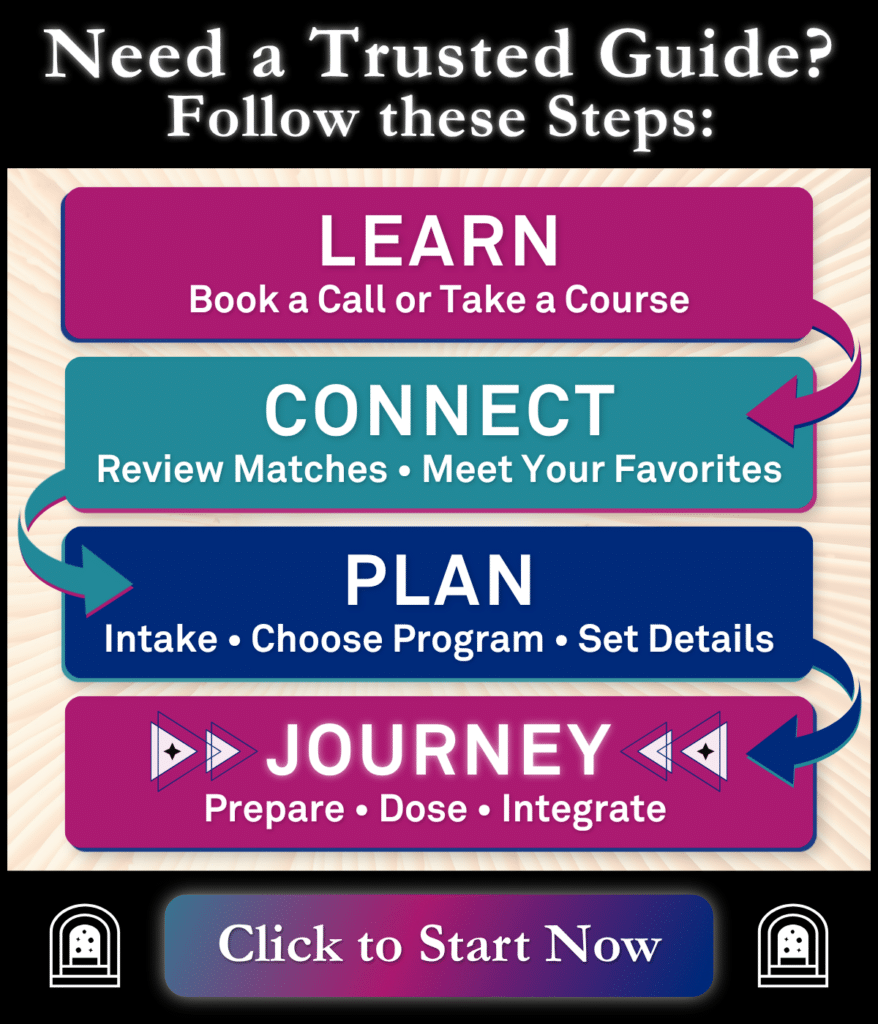
Psychedelic Passage has created a straightforward process that demystifies every major decision of the psychedelic therapy search process, with emphasis on:
- Connecting you to a network of pre-vetted service providers
- Customizing the therapeutic approach to your specific needs, and
- Simplifying logistical planning
Psychedelic Passage uses over 20 data points to provide you with potential facilitator matches that best suit your preferences, needs, and ideal approach to psychedelic therapy. The service is multi-step and free, which lowers risks and streamlines the psychedelic therapy search process. Psychedelic therapy seekers only pay when they commit to a program with a facilitator.
Connecting psychedelic therapy seekers to service providers simply isn’t enough. That’s why Psychedelic Passage has created a care ecosystem focused on:
- Education and skill building through workshops, online events, and written resources
- Peer support through a 6000+ member online community
- Administrative and logistical support from the concierge and operational team

Does Psychedelic Passage Offer Psilocybin Therapy in Georgia?
Yes, Psychedelic Passage offers services in Georgia through virtual Microdose Coaching and at-home Macrodose Programs. To date, Psychedelic Passage has:
- Fostered 67+ introductions for Georgia residents to vetted psychedelic care providers
- Completed 33+ psychedelic therapy programs for Georgia residents
- Has over 78 Georgia residents in our online psychedelic support community
Where Has Psychedelic Passage Conducted Programs In Georgia?
Of the 33+ psychedelic therapy programs, Psychedelic Passage has provided services for Georgia residents from the following towns and cities:
- Acworth
- Alpharetta
- Athens
- Atlanta
- Augusta
- Buford
- Blairsville
- Cartersville
- Columbus
- Cumming
- Duluth
- Gainesville
- Hartsfield
- Johns Creek
- Leesburg
- Marietta
- McDonough
- Savannah
Psychedelic Passage’s Track Record & Ratings
Here are some statistics about Psychedelic Passage’s professional performance rating:
- Has conducted over 13,000 concierge calls
- Has introduced over 6,000 individuals to professional psychedelic care through their matchmaking service
- Holds a 97% satisfaction rating across 2500+ Microdose and Macrodose Programs
- Maintains a 5-star Google Review rating and 4.9 stars on both Spotify and Apple for its psychedelic culture and education podcast
Reviews
To see more, visit our reviews page.
“The process was smooth, and having my facilitator here was absolutely necessary. I couldn’t have done it without her.”
– Macrodose Program Participant 2025
“My facilitator listened very carefully and answered all my questions very thoughtfully, with plenty of flexibility.”
– Pathfinding Participant 2026
Find Your Guide
References
Adult Ranking | Mental Health America. (2025, March 5). Mental Health America. https://mhanational.org/the-state-of-mental-health-in-america/data-rankings/adult-ranking
Appalachian Learning Initiative. (n.d.). Georgia Social Determinants Data. Appalachian Learning Initiative. Retrieved November 4, 2026, from https://www.appli.org/georgia/ga-social-determinants
Controlled substances; schedule I; psilocybin; revise a provision. (2026, July). Georgia Commons; Georgia Civic Data. https://georgiacommons.org/bills/2025-2026/hb382/full-text
Medical practice act; regulation of the administration of psychedelic-assisted treatment and therapy; provide. (2026, July). Georgia Commons; Georgia Civic Data. https://georgiacommons.org/bills/2025-2026/hb717/full-text
Psychedelics Legalization & Decriminalization Tracker. (2026). In Psychedelic Alpha. https://psychedelicalpha.com/resources/psychedelic-laws
United States Census Bureau. (2023). Explore Census Data. Data.Census.Gov. https://data.census.gov/profile/Georgia?g=040XX00US13

Jimmy Nguyen
Related Articles
- Preparing for a Psychedelic Journey: A Step-by-Step Guide
- How to Avoid Consumerist Traps in the Psychedelic Industry
- What’s the Difference Between Psychedelic Therapy and Psychedelic Coaching?
- What to Look For in a Psychedelic Guide or Therapist
- Is Your Therapist Psychedelic-Friendly? Why You Should Care