

Summary Brief
Though New York’s proposed state-run psychedelic therapy program has yet to be passed, there are options available now to New Yorkers primarily through qualified private facilitation services and ketamine clinics. Even though New York is ranked #1 in adult mental healthcare, 1 in 4 residents report an unmet need for treatment, noting the rise in demand for psychedelic therapy as it becomes recognized as a valid mental health treatment option. Psychedelic Passage is a service that helps individuals find psychedelic therapy today, offering a navigable route to private psilocybin microdose and macrodose programs by connecting New Yorkers with local, pre-vetted service providers.
To learn more about psychedelic therapy in another state, please refer to Psychedelic Passage’s locations page.
Key Takeaways
- Current Psychedelic Therapy Options: Ketamine-assisted therapy clinics and private facilitation are the two current pathways within New York, with clinical trials serving as a limited third route for those who qualify.
- Legal Status: Psilocybin and other therapeutic psychedelic compounds are federally classified as Schedule I. However, two notable bills are in progress: AO 9583 proposes a state-run research program focused on ibogaine for veterans with PTSD, and S 5303 introduces therapeutic and medical programs for psilocybin use.
- Market Challenge: Those seeking psychedelic therapy now face an environment lacking standards of service and regulatory clarity, making it difficult to discern quality and fit of psychedelic therapy providers.
- Psychedelic Passage’s Solution: With over 491 introductions and 130 psychedelic therapy programs completed in New York, Psychedelic Passage has a proven track record of providing the psychedelic curious a clear path toward legitimate psychedelic care.
Start your Pathfinding today
Our network of vetted, professional guides are here to help you through every step of your journey. We offer a free online course or a 15-minute phone call to help you find the best facilitator match for your unique needs.
What Are New Yorkers’ Options for Psychedelic Therapy?
There are several therapeutic psychedelic pathways for state residents, each with its own set of pros and cons. Some of these require out-of-state travel unless you choose ketamine therapy or an at-home program with Psychedelic Passage. The options are:
Domestic or International Psychedelic Retreats
State-Regulated Psychedelic Therapy Programs
An at-home Microdose or Macrodose Program with Psychedelic Passage
For a deep dive on these options, including features, limitations, and what to consider, check out this article here: Exploring the Landscape: Navigating Legal and Alternative Avenues of Psychedelic Care in the U.S.
Is Psychedelic Therapy Legal in New York?
Psychedelic therapy remains federally illegal across the United States, and even though New York hasn’t made any notable progress towards legalization, the introduction of psychedelic legislation does show promise.
While there has been a lot of psychedelic legislation introduced in recent years, none have passed; therefore, there are no frameworks for legal psychedelic therapy in New York. Despite that, there are still accessible pathways for those looking for psychedelic therapy.
Is There Any Current Psychedelic Legislation in New York?
The most notable recent legislation in New York is AO 9583, which would create a state-run research program (clinical trials) focusing on ibogaine and veterans with PTSD (updates here), and S 5303, which proposes the creation of a state program for therapeutic and medical psilocybin use (updates here).
While the legislation hasn’t made any marked progress, the future of psychedelic therapy in New York shows promise because it shows that some lawmakers are anticipating and preparing for potential legalization.
What New York Institutions Research Psychedelics?
We have identified one notable New York institution interested in psychedelic research and therapy: the Stratton VA Medical Center in Albany, NY.
They recently conducted research to collect data on questions, concerns, hopes, and expectations from veterans about a hypothetical situation regarding MDMA-assisted therapy for PTSD.
This effort to gain veterans’ insights to inform future studies is extremely promising and shows earnest, well-intended progress. And while there are still barriers to psychedelic therapy being legal statewide, there are valid psychedelic therapy options that New York residents can access today.
Why Does Access to Psychedelic Therapy Matter for New York?
According to New York’s Department of Health, social determinants of health, such as income, housing stability, employment opportunities, and education, are critical factors that shape varying levels of access to mental health care.
New York’s 2022 Social Determinants of Health Survey reported 14% of NYC adults having serious psychological distress (SPD), compared with 7% in 2017, with the number of adults suffering from SPD doubling in just 5 years, outlining a need for access to better healthcare.
New York Socioeconomic Statistics Relevant to Psychedelic Therapy
These statistics from the 2020 US Census provide context to these various conditions of health, well-being, and standards of living in New York that are relevant to social determinants of health:
- $81,228 median household income (5.17% above US average)
- 14% of New York residents at poverty level (1.9% above US average)
- 41.2% with a Bachelor’s degree or higher (4.4% above US average)
- 59.5% employment rate (1.1% below US average)
- $1,634 median gross rent ($147 above US average)
- 5.0% without health care coverage (2.8% less than US average)
Social determinants like these strongly correlate with an individual’s overall health and access to care. While these numbers paint a pretty average picture of New York residents, these factors are not evenly distributed across the population; therefore, access to care remains limited.
With psychedelic therapy on the rise as a legitimate wellness option, it offers additional pathways for New York residents as they pursue healthier minds and lives.
New York Sociodemographic Statistics Relevant to Psychedelic Therapy
New York has a population of over 20 million people, with the following subpopulations highlighted as they each lack equitable access to, and at the same time can particularly benefit from, psychedelic therapy, as evidenced by psychedelic-focused academic research initiatives and sociocultural analyses:
- 3.5% veteran population (over 700,000 individuals, 2.4% below total US percentage)
- 13.5% disabled population (over 2.7 million individuals)
- 149,000+ New York residents with indigenous lineage
Looking for culturally-tailored, Indigenous-led mental health support? Check out Urban Indigenous Collective, situated in Manhattan, NYC, a place with a rich history in the Lenape, the Manahatin, the Canarsie, the Shinnecock, the Reckgawanc, Munsee, and Haudenosaunee Nations.
New York Mental Health Statistics Relevant to Psychedelic Therapy
New York ranks 1st overall in adult mental health care according to a 2025 report by Mental Health America. This means that it has the lowest prevalence of mental illness and higher rates of access to care for adults in the country. New York also has a ratio of 280 individuals per 1 mental health care provider, ranking 18th in the U.S.
For New York, according to the same report:
- 21.29% or 3,293,000 individuals experienced a mental illness in 2024
- 20.68% or 449,469 individuals had 14+ mentally unhealthy days a month but could not seek care in 2023
- 25.9% or 378,000 people reported an unmet need for treatment in 2022–2023
- 17.83% or 2,757,000 people cited substance use disorder in 2024; 74.9% (about 2.35 million people) considered but did not receive treatment in 2023
These statistics show that, on average, New Yorkers have the best mental health care in the country; however, it also reveals that there are still millions of individuals suffering from mental illness and unable to receive care.
With New York ranking #1 in healthcare, it would benefit the state to continue to stay on the forefront of emerging wellness therapies like psychedelics and evolve alongside the scientific understanding of them.
As more and more residents turn to therapeutic psychedelic use in conjunction with conventional mental health and general well-being approaches, there are many barriers that psychedelic therapy seekers face in finding qualified and individualized care.
What are the Challenges in Finding Psychedelic Therapy?
Despite the many options available, finding the right psychedelic therapy provider can be a lengthy and overwhelming process, sometimes taking an individual months or even years to find appropriate care.
What makes this process even harder is that there are no universal standards to qualify a psychedelic professional. For example:
- State-approved training programs don’t require actual psychedelic experience for licensure
- There is no central regulatory body or oversight committee for psychedelic practitioners
- There are few safeguards blocking bad actors or those with falsified credentials
This is why it is difficult to find a trusted professional with direct experience addressing your issues, wants, and needs. And even if you do find a qualified psychedelic service provider, there are still many logistical considerations to decide.
How Does Psychedelic Passage Solve These Issues?
Psychedelic Passage is an advocate for the psychedelic-curious and those seeking psychedelic therapy, operating as a portal to research-backed information, support resources, and actionable pathways toward legitimate psychedelic care.
About the Facilitator Network
Those seeking professional psychedelic care should not only have access to a wide range of options specific to their ideal therapeutic approach, but also access to choices that align with the desired personality traits and skill of the therapist, facilitator, or guide. The guides in Psychedelic Passage’s vetted referral network carry a diverse array of backgrounds such as:
- Psychotherapy and Psychiatry
- Psychiatric Nursing
- Academics and PhD’s
- Certified Coaches
- Indigenous lineage medicine keepers
- Master ceremonialists
To be part of the referral network, these facilitators undergo a rigorous 40-point application, multi-stage interview process, professional and client reference checks, and a criminal background check.
To learn more about the vetting criteria and qualifications of Psychedelic Passage’s Referral Network, visit this page here.
About the Concierge & Matchmaking Process
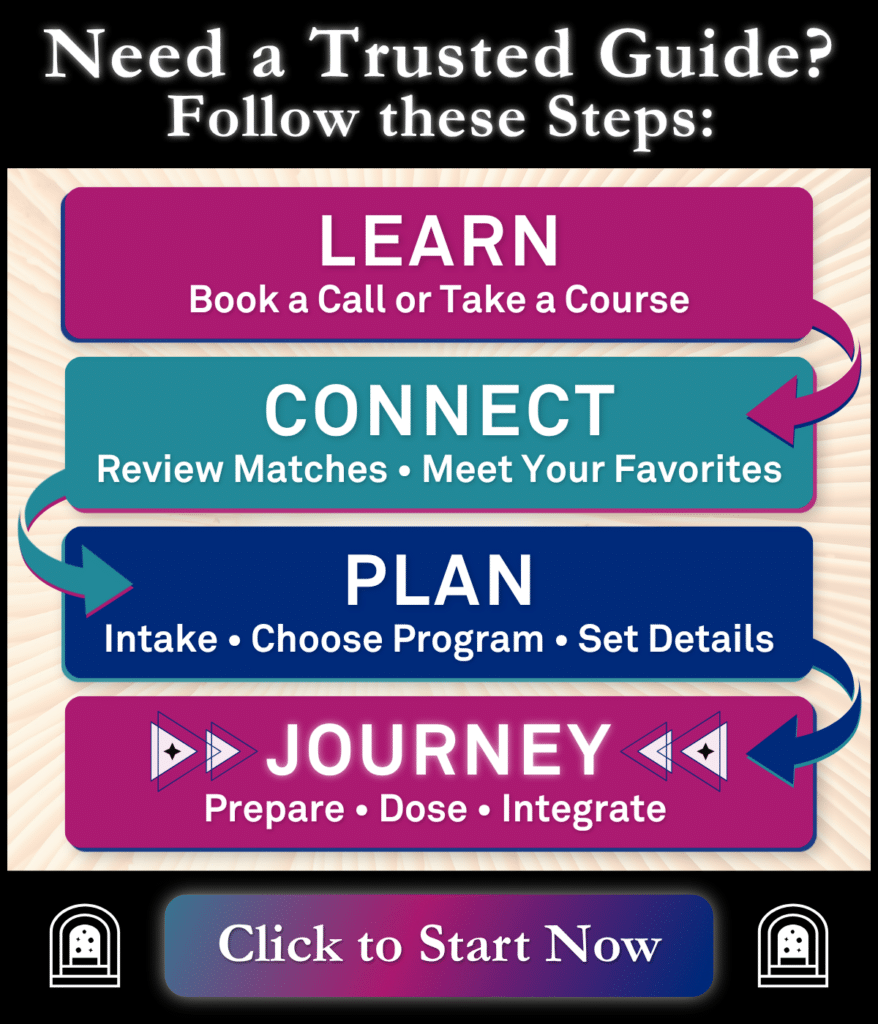
Psychedelic Passage has created a straightforward process that demystifies every major decision of the psychedelic therapy search process, with emphasis on:
- Connecting you to a network of pre-vetted service providers
- Customizing the therapeutic approach to your specific needs, and
- Simplifying logistical planning
Psychedelic Passage uses over 20 data points to provide you with potential facilitator matches that best suit your preferences, needs, and ideal approach to psychedelic therapy. The service is multi-step and free, which lowers risks and streamlines the psychedelic therapy search process. Psychedelic therapy seekers only pay when they commit to a program with a facilitator.
Connecting psychedelic therapy seekers to service providers simply isn’t enough. That’s why Psychedelic Passage has created a care ecosystem focused on:
- Education and skill building through workshops, online events, and written resources
- Peer support through a 6000+ member online community
- Administrative and logistical support from the concierge and operational team

Does Psychedelic Passage Offer Psilocybin Therapy in New York?
Yes, Psychedelic Passage offers services to New Yorkers through virtual Microdose Coaching and at-home Macrodose Programs. To date, Psychedelic Passage has:
- Fostered 491+ introductions for New York residents to vetted psychedelic care providers
- Completed 130+ psychedelic therapy programs for NY residents
- Has over 166 New Yorkers in our online psychedelic support community
Where Has Psychedelic Passage Conducted Programs In New York?
Of the 130+ psychedelic therapy programs, Psychedelic Passage has provided services for New York residents from the following locations:
Albany
Bronxville
Brooklyn
Buffalo
Catskill
Chappaqua
Commack
East Hampton
East Northport
Eastchester
Floral Park
Ithaca
Lima
Long Island
Malverne
Manhattan
New York City
North Tonawanda
Old Westbury
Ossining
Oyster Bay
Queens
Rochester
Roslyn
Scarsdale
Sea Cliff
Stratford
Syracuse
The Bronx
Wantagh
Wappinger Falls
West Islip
Westbury
Westchester
Westhampton
Westport
Psychedelic Passage’s Track Record & Ratings
Here are some statistics about Psychedelic Passage’s professional performance rating:
- Has conducted over 13,000 concierge calls
- Has introduced over 6,000 individuals to professional psychedelic care through their matchmaking service
- Holds a 97% satisfaction rating across 2500+ Microdose and Macrodose Programs
- Maintains a 5-star Google Review rating and 4.9 stars on both Spotify and Apple for its psychedelic culture and education podcast
Testimonials
To see more, visit our testimonials page.
“It was a wonderful experience, deep and healing. I felt connected and very comfortable with my facilitator from the first time we spoke, and he held such a calm, kind, knowledgeable and safe space for me during my journey that I was able to get even more than I had hoped from the experience.”
– Macrodose Program Participant 2025
“My facilitator was authentic, genuine and sincere while she educated me on the whole process with Psychedelic Passage. She answered each of my questions completely and placed me at ease.”
– Pathfinding Participant 2026
Find Your Guide
References
(2026). Clinicaltrials.Gov. https://clinicaltrials.gov/study/nct05895318
Adult Ranking | Mental Health America. (2025, March 5). Mental Health America. https://mhanational.org/the-state-of-mental-health-in-america/data-rankings/adult-ranking
Explore Census Data. (2020). Data.Census.Gov. https://data.census.gov/profile/New_York?g=040XX00US36
Psychedelics Legalization & Decriminalization Tracker. (2026). In Psychedelic Alpha. https://psychedelicalpha.com/resources/psychedelic-laws
Social Determinants of Health and Community Based Organizations. (n.d.). Www.Health.Ny.Gov. Retrieved September 25, 2026, from https://www.health.ny.gov/health_care/medicaid/redesign/sdh
Social Determinants of Mental Health among New York City Adults. (2023). https://www.nyc.gov/assets/doh/downloads/pdf/epi/databrief139.pdf

Heather Gureckis
Related Articles
- Preparing for a Psychedelic Journey: A Step-by-Step Guide
- How to Avoid Consumerist Traps in the Psychedelic Industry
- What’s the Difference Between Psychedelic Therapy and Psychedelic Coaching?
- What to Look For in a Psychedelic Guide or Therapist
- Is Your Therapist Psychedelic-Friendly? Why You Should Care