

Summary Brief
Psychedelic therapy is available in North Carolina, despite not having a state-regulated access program. Residents can find psychedelic services primarily through ketamine therapy services and vetted private facilitation programs. Without any legislation in place, many seeking psychedelic therapy are left to their own devices to find other avenues. Psychedelic Passage offers a streamlined approach to finding at-home psilocybin microdose and macrodose programs by connecting individuals with pre-vetted qualified providers across North Carolina.
To learn more about psychedelic therapy in another state, please refer to Psychedelic Passage’s locations page.
Key Takeaways
- Current Psychedelic Therapy Options: Private facilitation, ketamine-assisted therapy, and clinical trials are the main pathways in North Carolina for local psychedelic care today.
- Legal Status: Psilocybin and most psychedelics are federally classified as Schedule I, and North Carolina hasn’t made any progress in the legalization of these substances, other than the introduction of legislation for psychedelic research.
- Market Challenge: The lack of a standardized framework for psychedelic services and regulatory policy in the state creates barriers and a complex landscape for those seeking psychedelic therapy.
- Psychedelic Passage’s Solution: With over 117 introductions and 88 psychedelic therapy programs completed in North Carolina, Psychedelic Passage provides a clear path to vetted facilitators and personalized care plans.
Start your Pathfinding today
Our network of vetted, professional guides are here to help you through every step of your journey. We offer a free online course or a 15-minute phone call to help you find the best facilitator match for your unique needs.
What Are Your Options for Psychedelic Therapy as a North Carolina Resident?
There are several therapeutic psychedelic pathways for state residents, each with its own set of pros and cons. Some of these require out-of-state travel unless you choose ketamine therapy or an at-home program with Psychedelic Passage. The options are:
Domestic or International Psychedelic Retreats
State-Regulated Psychedelic Therapy Programs
An at-home Microdose or Macrodose Program with Psychedelic Passage
For a deep dive on these options, including features, limitations, and what to consider, check out this article here: Exploring the Landscape: Navigating Legal and Alternative Avenues of Psychedelic Care in the U.S.
Is Psychedelic Therapy Legal in North Carolina?
As of 2026, legislation has been proposed by lawmakers to create an avenue for scientific research into psychedelic “breakthrough treatments” for veterans.
While there aren’t state-regulated frameworks for psychedelic therapy in North Carolina, there are still options for those seeking pre-vetted and qualified psychedelic facilitators in your area.
Is There Any Current Psychedelic Legislation in North Carolina?
Psychedelic therapy remains federally illegal across the United States, but in North Carolina, the psychedelic legislation appears to be moving in a positive direction.
For example, SB 1018, the “HEAL Act,” proposes the establishment of a research fund for psychedelic substances that have been designated as “breakthrough therapy” by the FDA, including psilocybin, MDMA, and ibogaine (updates here).
SB 568, introduced in 2025, seeks to establish “The North Carolina Mental Health and Psychedelic Medicine Task Force,” meant to assess potential use of psychedelic medicine in the ongoing mental health crisis and make considerations in the event that psychedelic therapy becomes legal (updates here).
What North Carolina Institutions Research Psychedelics?
Psychedelic Passage’s writing team has identified institutions in North Carolina that are conducting academic and scientific research on psychedelics, namely clinical trials for psychedelic substances and analogs.
The Pearl Psychedelic Institute in Asheville, NC, was one of the few locations approved to host clinical trials for MDMA-assisted therapy for treatment-resistant PTSD through the FDA’s Expanded Access program with MAPS (no longer accepting participants, awaiting FDA & DEA decisions).
Even though they’re no longer recruiting for their MDMA clinical trials, the Pearl Institute does have a ketamine-assisted psychotherapy (KAP) center in Waynesville, NC, that some health insurance does cover.
UNC Chapel Hill Medical Center and Monroe Biomedical Research are the main institutions conducting psychedelic clinical trials, recently focusing on psilocybin or an analog for major depressive disorder (MDD) and treatment-resistant depression (TRD) – neither is accepting healthy participants, meaning you must at the very least be diagnosed with MDD or TRD to be considered for enrollment.
Progress in North Carolina isn’t extensive, but it is promising. And while there are still barriers to psychedelic therapy being legal statewide, there are valid psychedelic therapy options that residents can access today.
Why Does Access to Psychedelic Therapy Matter for North Carolina?
According to the North Carolina Department of Health and Human Services, several factors influence residents’ health and access to mental health care, including economic conditions, housing and transportation, and even social conditions.
North Carolina Socioeconomic Statistics Relevant to Psychedelic Therapy
These statistics from the 2020 US Census provide context to these various conditions of health, well-being, and standards of living in North Carolina that are relevant to social determinants of health:
- $73,958 median household income (9.3% below US average)
- 12.5% of North Carolina residents at poverty level (.4% above US average)
- 37.1% with a Bachelor’s degree or higher (.3% above US average)
- 59.8% employment rate (.8% below US average)
- $1,338 median gross rent ($149 below US average)
- 8.6% without health care coverage (.4% more than US average)
Many of these factors directly affect an individual’s overall health and access to care. Elected officials have pushed to improve North Carolinians’ social determinants of health, and by using the University of North Carolina at Chapel Hill’s interactive map, they can identify areas with the greatest need for assistance.
While it’s encouraging to see strategies emerging to address North Carolina’s most pressing societal issues, real people still struggle across the state as barriers to care persist.
With research into psychedelic therapy continuing to show positive results and gaining wider mainstream recognition, more North Carolina residents are seeking it out as they pursue healthier minds and lives, meaning the need for accessible pathways is growing.
North Carolina Sociodemographic Statistics Relevant to Psychedelic Therapy
North Carolina has a population of over 10 million people, with the following subpopulations highlighted as they each lack equitable access to, and at the same time can particularly benefit from, psychedelic therapy, as evidenced by psychedelic-focused academic research initiatives and sociocultural analyses:
- 7.2% veteran population (over 700,000 individuals, 1.3% above total US percentage)
- 14% disabled population (over 1.4 million individuals)
- 130,000+ North Carolina residents with indigenous lineage
North Carolina Mental Health Statistics Relevant to Psychedelic Therapy
North Carolina ranks 24th overall in adult mental health care according to a 2025 report by Mental Health America, revealing an average prevalence of mental illness and rate of access to care for adults compared to the rest of the country.
North Carolina also has a ratio of 320 individuals per 1 mental health care provider, ranking 27th in the U.S., which is average for the country but striking when you consider the real-world implications.
A whopping 47% of North Carolina women reported intimate partner violence, which can lead to severe mental and physical health implications that are not well understood, given the lack of scientific research and reporting of interpersonal violence towards women.
For North Carolina, according to the same report:
- 21.32% or 1,759,000 individuals experienced a mental illness in 2024
- 24.91% of individuals who had 14+ mentally unhealthy days a month could not seek care in 2023 (317,907 people)
- 24.6% of those with mental illness, or 169,000 people, reported an unmet need for treatment in 2022-2023
- 16.06% or 1,325,000 people cited substance use disorder in 2024; of those, 78.45% (about 1.16 million people) considered but did not receive treatment in 2023
While these statistics show that there are many suffering from mental health and related issues, why many North Carolina residents are seeking therapeutic psychedelic use, they also show that many still face an array of barriers to accessing the care they want or need.
What are the Challenges in Finding Psychedelic Therapy?
Despite the many options available, finding the right psychedelic therapy provider can be a lengthy and overwhelming process, sometimes taking an individual months or even years to find appropriate care.
What makes this process even harder is that there are no universal standards to qualify a psychedelic professional. For example:
- State-approved training programs don’t require actual psychedelic experience for licensure
- There is no central regulatory body or oversight committee for psychedelic practitioners
- There are few safeguards blocking bad actors or those with falsified credentials
This is why it is difficult to find a trusted professional with direct experience addressing your issues, wants, and needs. And even if you do find a qualified psychedelic service provider, there are still many logistical considerations to decide.
How Does Psychedelic Passage Solve These Issues?
Psychedelic Passage is an advocate for the psychedelic-curious and those seeking psychedelic therapy, operating as a portal to research-backed information, support resources, and actionable pathways toward legitimate psychedelic care.
About the Facilitator Network
Those seeking professional psychedelic care should not only have access to a wide range of options specific to their ideal therapeutic approach, but also access to choices that align with the desired personality traits and skill of the therapist, facilitator, or guide. The guides in Psychedelic Passage’s vetted referral network carry a diverse array of backgrounds such as:
- Psychotherapy and Psychiatry
- Psychiatric Nursing
- Academics and PhD’s
- Certified Coaches
- Indigenous lineage medicine keepers
- Master ceremonialists
To be part of the referral network, these facilitators undergo a rigorous 40-point application, multi-stage interview process, professional and client reference checks, and a criminal background check.
To learn more about the vetting criteria and qualifications of Psychedelic Passage’s Referral Network, visit this page here.
About the Concierge & Matchmaking Process
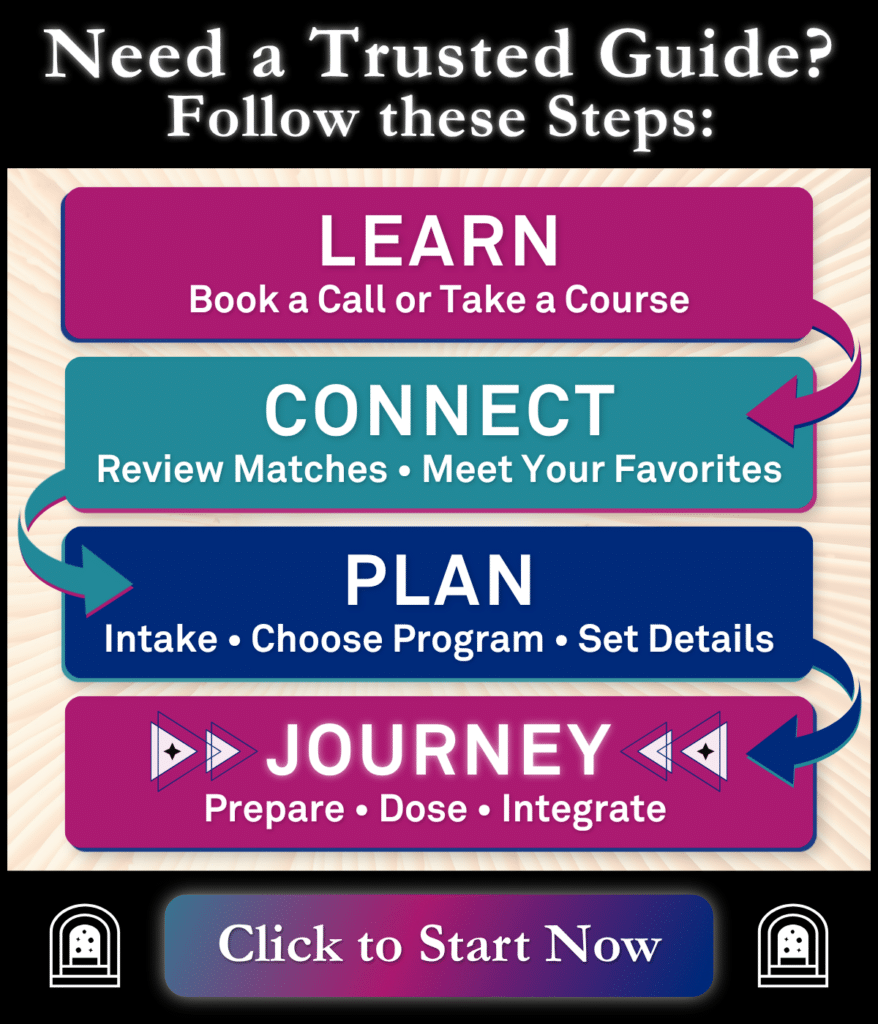
Psychedelic Passage has created a straightforward process that demystifies every major decision of the psychedelic therapy search process, with emphasis on:
- Connecting you to a network of pre-vetted service providers
- Customizing the therapeutic approach to your specific needs, and
- Simplifying logistical planning
Psychedelic Passage uses over 20 data points to provide you with potential facilitator matches that best suit your preferences, needs, and ideal approach to psychedelic therapy. The service is multi-step and free, which lowers risks and streamlines the psychedelic therapy search process. Psychedelic therapy seekers only pay when they commit to a program with a facilitator.
Connecting psychedelic therapy seekers to service providers simply isn’t enough. That’s why Psychedelic Passage has created a care ecosystem focused on:
- Education and skill building through workshops, online events, and written resources
- Peer support through a 6000+ member online community
- Administrative and logistical support from the concierge and operational team

Does Psychedelic Passage Offer Psilocybin Therapy in North Carolina?
Yes, Psychedelic Passage offers services in North Carolina through virtual Microdose Coaching and at-home Macrodose Programs. To date, Psychedelic Passage has:
- Fostered 117+ introductions for North Carolina residents to vetted psychedelic care providers
- Completed 88+ psychedelic therapy programs for North Carolina residents
- Has over 145 North Carolina residents in our online psychedelic support community
Where Has Psychedelic Passage Conducted Programs In North Carolina?
Of the 88+ psychedelic therapy programs, Psychedelic Passage has provided services for North Carolina residents from the following towns and cities:
Aberdeen
Apex
Ashboro
Asheville
Avon
Black Mountain
Boone
Cary
Charlotte
Clayton
Concord
Davidson
Durham
Fayetteville
Fletcher
Greensboro
Hendersonville
High Point
Highlands
Hillsborough
Horse Shoe
Huntersville
Jacksonville
Marshall
Matthews
Monroe
Newburn
Purlear
Raleigh
Southern Shores
Willmington
Winston-Salem
Psychedelic Passage’s Track Record & Ratings
Here are some statistics about Psychedelic Passage’s professional performance rating:
- Has conducted over 13,000 concierge calls
- Has introduced over 6,000 individuals to professional psychedelic care through their matchmaking service
- Holds a 97% satisfaction rating across 2500+ Microdose and Macrodose Programs
- Maintains a 5-star Google Review rating and 4.9 stars on both Spotify and Apple for its psychedelic culture and education podcast
Testimonials
To see more, visit our reviews page.
“My facilitator was very respectful, he explained the entire process clearly, and he was a calm presence without being intrusive during the dosing session.”
– Macrodose Program Participant 2026
“The facilitator that I spoke to on the phone was very kind, empathetic, sympathetic, and knowledgeable. She answered all of my questions and made me feel very comfortable about the process.”
– Pathfinding Participant 2026
Find Your Guide
References
Adult Ranking | Mental Health America. (2025, March 5). Mental Health America. https://mhanational.org/the-state-of-mental-health-in-america/data-rankings/adult-ranking
Interactive GIS Map | NCDHHS. (2016). Ncdhhs.Gov. https://www.ncdhhs.gov/about/department-initiatives/healthy-opportunities/interactive-gis-map
NCDHHS: About Healthy Opportunities. (n.d.). Www.Ncdhhs.Gov. Retrieved September 28, 2026, from https://www.ncdhhs.gov/about/department-initiatives/healthy-opportunities/about-healthy-opportunities
Psychedelics Legalization & Decriminalization Tracker. (2026). In Psychedelic Alpha. https://psychedelicalpha.com/resources/psychedelic-laws
United States Census Bureau. (2023). Explore Census Data. Data.Census.Gov. https://data.census.gov/profile/North_Carolina?g=040XX00US37

Chad Eschman
Related Articles
- Preparing for a Psychedelic Journey: A Step-by-Step Guide
- How to Avoid Consumerist Traps in the Psychedelic Industry
- What’s the Difference Between Psychedelic Therapy and Psychedelic Coaching?
- What to Look For in a Psychedelic Guide or Therapist
- Is Your Therapist Psychedelic-Friendly? Why You Should Care